Case Study
Spinoza Ethics Interactive Visualisation
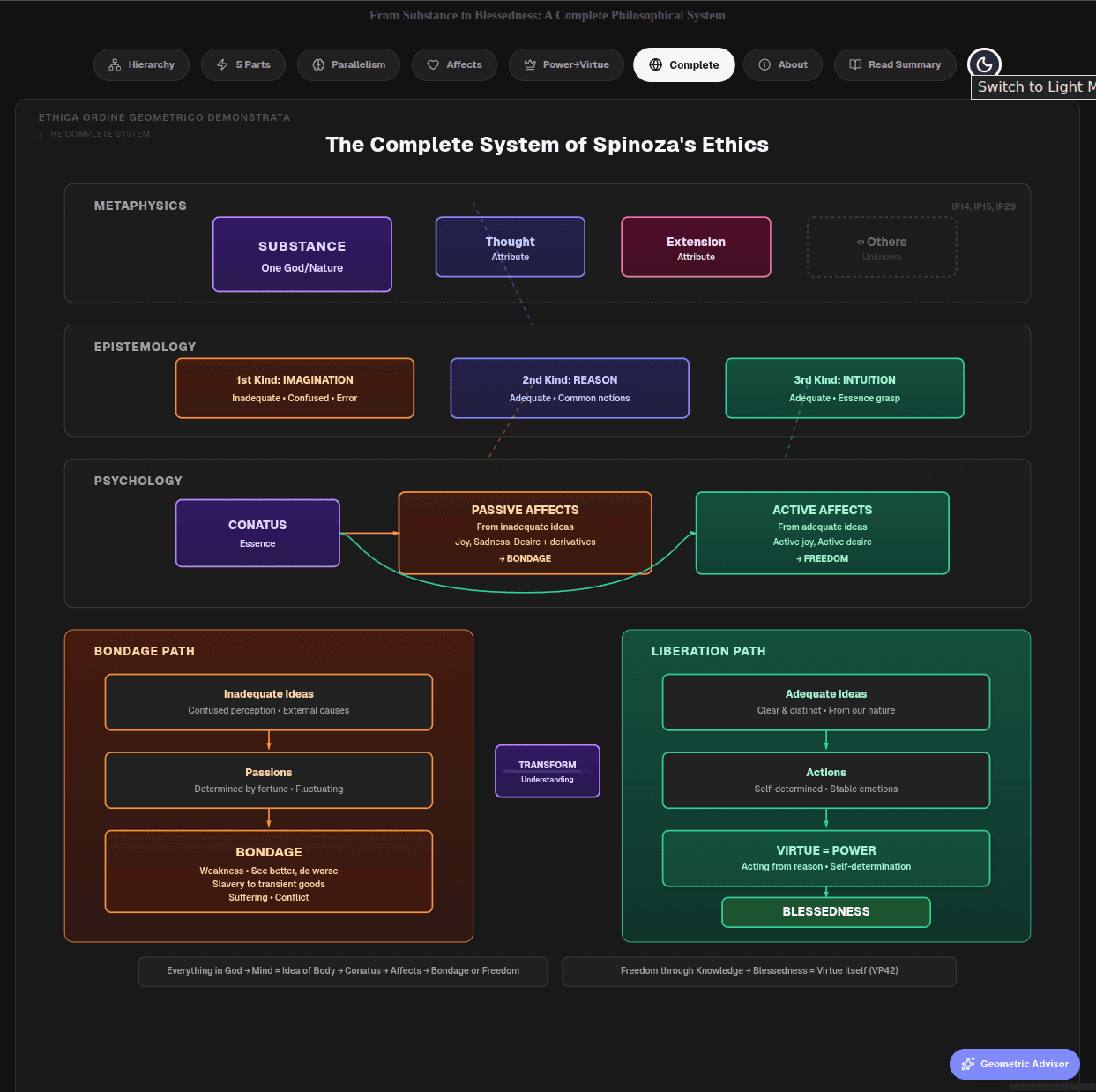
An interactive web application that renders Baruch Spinoza's Ethics as a formally navigable deductive system, making one of philosophy's most structurally rigorous texts explorable through graph visualization. The Ethics is composed entirely of definitions, axioms, propositions, demonstrations, and corollaries arranged in strict geometrical order — each claim proven from prior ones in an unbroken chain from metaphysical foundations to conclusions about human freedom and the good life. This application parses the full dependency structure of the text and represents it as an interactive directed graph, where nodes correspond to individual propositions and edges encode logical dependencies between them. Users can select any node to read the full text, trace its proof ancestry back to the foundational axioms, or explore its downstream consequences forward through the system. Built with TypeScript and graph layout algorithms, the project bridges digital humanities and software engineering, providing scholars, students, and curious readers a spatial, networked view of a philosophical argument that rewards structural analysis.
Role
Full-Stack Developer
Duration
3 weeks
Tech Stack
The Problem
Spinoza's Ethics is one of the most logically rigorous philosophical texts ever written — 250+ propositions arranged in strict geometrical order, each proven from definitions, axioms, and prior propositions in an unbroken deductive chain. Reading it linearly obscures the underlying dependency structure: it is nearly impossible to trace which propositions rest on which axioms, navigate forward through a chain of consequences, or grasp the ontological architecture as a whole without losing your place. No existing digital edition made the logical graph navigable.
My Approach
The application models the full Ethics as a directed acyclic graph. Each proposition, axiom, definition, and corollary becomes a node; each logical dependency becomes a directed edge. Five purpose-built diagram types were designed to surface different structural dimensions of the text: 1. Hierarchy — the full ontological tree from foundational axioms to derived conclusions 2. Causal Flow — the propagation path from God/Substance through modes to finite things 3. Mind/Body Parallelism — the correspondence structure between the two attributes 4. Affects — the transition arc from bondage (passive affects) toward freedom (active reason) 5. Power & Virtue — the ethical implications network linking conatus, virtue, and the good life A Groq-powered "Geometric Advisor" AI chatbot was integrated using the Llama 3.3 70B model, constrained to respond in Spinoza's own axiomatic register — offering explanations structured as definitions, axioms, and demonstrations rather than informal prose. State is managed via two React Contexts (SpinozaContext and ThemeContext). The full dependency graph is stored as structured JSON, enabling pure client-side navigation without a backend.
Results & Impact
Delivered a fully interactive philosophical navigation tool that makes the logical structure of the Ethics spatially and visually explorable for the first time in a modern web format. Users can select any proposition, read its full text, trace its proof ancestry back to foundational axioms, and explore its downstream consequences forward through the system. The Groq AI advisor adds an interactive pedagogical layer for students and scholars. Deployed to Vercel at spinoza-ethics.vercel.app.